
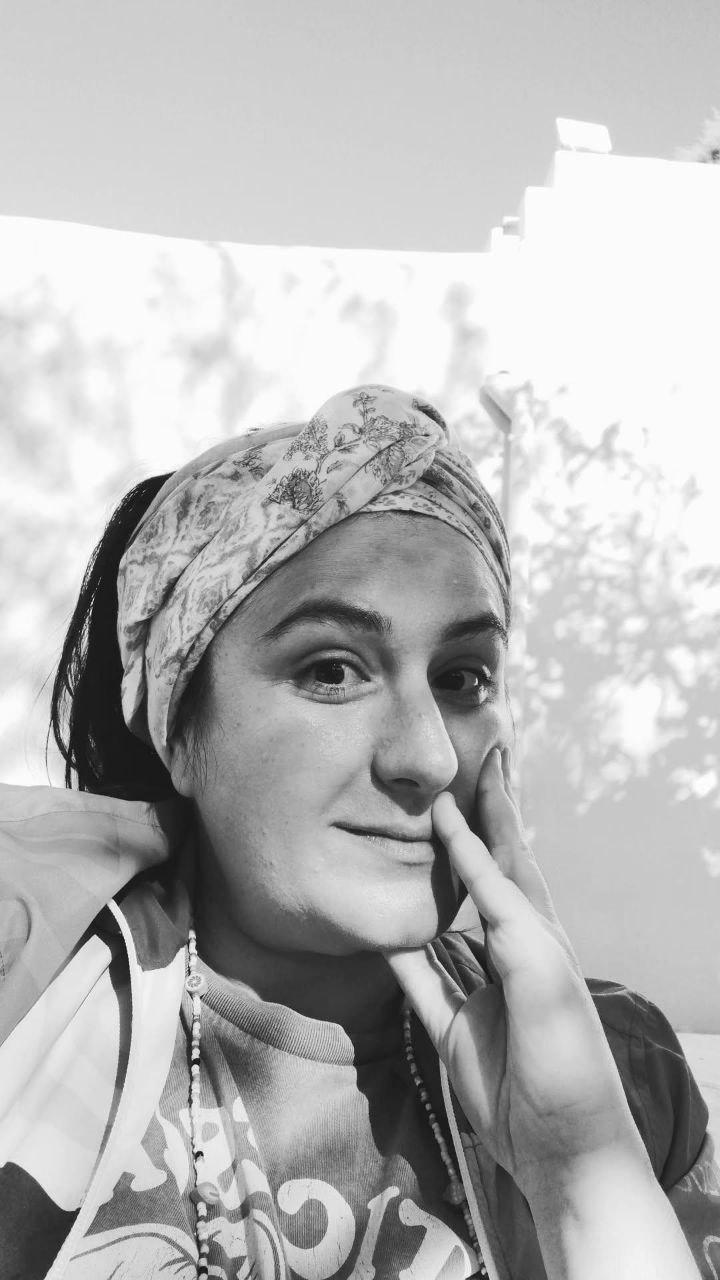
Multilingual Masking
audio version available at bottom of page
I was raised bilingual. My parents were immigrants and only spoke to me in Greek. Most of their community in the Americas were also Greek diaspora.
As Greek was the language of the home, I didn’t start speaking English right away. The biggest jump in my speech came when I was around 18 months old. My father had an emergency quintuple bypass and my aunt from Canada took care of me over the weeks he was in and out of hospital.
Suddenly, the language I heard coming out of the TV or in passing at the supermarket became real. A language that had felt inherently foreign started to become safe.
According to my parents, soon after my father’s recovery I started translating from Greek into English for the few non-Greek aunties and cousins who sat at our table at family gatherings. This is the story of how I became bilingual.
The language in my house was Greek, and the language in the world around me was English. I was born between worlds, two languages shaping how I processed. In time they shaped how I presented.
This is a common experience for people of the diaspora: being something in-between the two places your family calls home. A complex layer is added when you factor in a neurodivergent processing system. Now you’re not just masking; you’re masking in different languages.
This all becomes even more complex when you consider language as socially contextual. When I moved to China for my first teaching contract abroad, I had several conversations with local friends about how their English personas were more emotionally communicative, while their Chinese personas were quieter, more reserved.
The persona I developed at home in Greek was likely my most authentic. I don’t feel I mask heavily in my day-to-day conversations with my mother. There’s a lack of expressiveness, sure, but it doesn’t feel fake. She simply didn’t model emotional depth.
And this is understandable in the context of my family’s history. My father was born at the end of WWII. In the aftermath, as the occupying German and Italian forces left, civil war erupted. This eventually led to a military junta, which was when my mother came of age. Both parents grew up in the same village in rural Boeotia without the modern amenities of many of their western contemporaries.
Salt of the earth though they are, my family simply did not speak about emotions. It was not a luxury afforded to them in their upbringing, and so it was not an integral part of how they raised me.
And this experience – lacking communication about emotions in the home – was paralleled in the experiences of my Chinese friends. We talked about this shift in expression from the home self to the public self, and how the public self was different depending on the languages we spoke.
For us, English allowed for more emotional depth. And so the personas we were in those conversations together, they were the English versions of ourselves.
We shared things in our second language we did not dare speak in our mother tongues. We had faces to our multilingual selves that simply did not translate when the language changed.
This experience of the multilingual self is only truly understood amongst those of us with this shared experience – and only when we understand our own fragmentation across languages.
For me, this required an acceptance that Greek Maria in the home may not have masked very much, but she also had no emotional intelligence in her native tongue. This intelligence wasn’t modeled by the adults around her. Speaking was almost robotic in its dimensionality, lacking deeper expression I had heard and seen my American friends display.
And the Maria I use within Greek communities? The persona I developed for socializing, the voice I use with elders and strangers – I’m not sure who that person is. She is an amalgamation of parroted speech, chattering almost absent-mindedly, loudly and with enthusiasm in a language that is simultaneously native and foreign.
Greek Maria is animated and smiley, always positive, spewing platitudes of good health, good week, happy this and happy that. The language learned in my home environment didn’t give me a clear pathway to share sadness or grief, and I’ve only begun to truly learn this since I repatriated to Greece five years ago.
Being here during the most trying time of my illness and recovery forced an authentic voice to emerge. Speaking about depression, pain and anxiety, and explaining severe symptoms and complex medical history required more – an honesty I hadn’t learned, a vocabulary I hadn’t accessed.
It turns out that during a crisis, platitudes are no longer sufficient. Crisis demanded a different Greek from me.
So the emotional depth I had been slowly learning in English began to shift its way into Greek. The mask of the endlessly bubbly, everything-is-fine Greek woman started to fall away.
I am no longer just a caricature of aunties. I am becoming myself.
Audio of piece read by me: